On December 12th at noon, in the conference room of the National Astronomical Observatories of the Chinese Academy of Sciences in Beijing, researchers Liu Jifeng and Wang Yanan, along with Associate Professor Huang Yang from the University of Chinese Academy of Sciences and Professor Lei Weihua from Huazhong University of Science and Technology, were focusing on a "cosmic storm" 120 million light-years away—a star being torn apart by a supermassive black hole, with the remnant forming a hot accretion disk and driving the jets to oscillate synchronously. Just one day earlier, their research, published in *Science Advances* in collaboration with more than 30 domestic and international institutions, provided the first strong observational evidence in the tidal disruption event (TDE) AT2020afhd, "seeing clearly" the "dance" of the black hole system—the coordinated precession of the accretion disk and the jets.
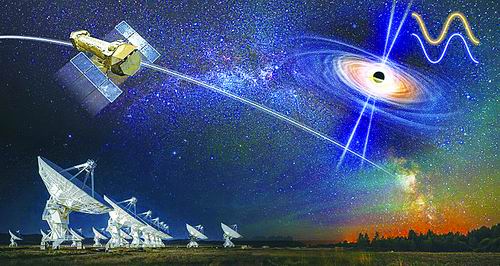
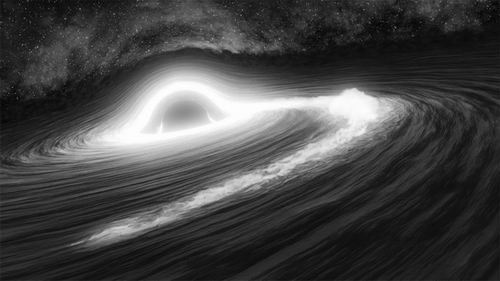
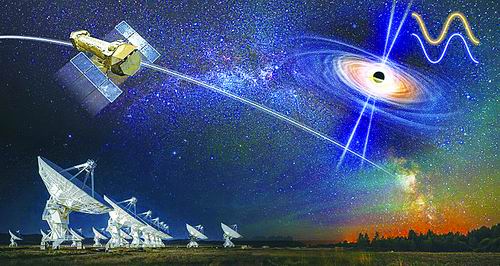
An artist's rendering of the coordinated precession of the accretion disk and jet of a black hole system. Illustration by Zhang Xu. Image provided by the National Astronomical Observatories, Chinese Academy of Sciences.
AT2020afhd is located at the center of the galaxy LEDA 145386, approximately 120 million light-years from Earth. Tidal disintegration events are violent astronomical phenomena that occur when stars get too close to a supermassive black hole at the center of a galaxy and are torn apart by its powerful tidal forces. Some stellar debris forms a hot accretion disk during its fall, releasing intense radiation. The team believes that the synchronous precession of the accretion disk and jets likely originates from the Lance Thieling effect predicted by general relativity, where a rotating black hole drags around spacetime, causing the tilted accretion disk and its vertical jets to oscillate periodically. Although theory has long predicted the "dancing" behavior of black hole systems, obtaining clear observational evidence is extremely challenging.
In January 2024, Wang Yanan noticed AT2020afhd through the "Temporary Source Name Service Network". "After discovering that this event had X-ray radiation, we immediately triggered higher-frequency X-ray monitoring," she said. "But at the time, we did not expect this source to be so special. It wasn't until a month of monitoring that we discovered a dramatic change in the luminosity of its X-ray radiation." The team decided to launch intensive monitoring, and thus quickly organized international collaborative observations, carrying out multi-band high-frequency observations for more than a year.
A turning point came 215 days after the event was discovered: the X-ray light variation exhibited quasi-periodic oscillations with a period of approximately 19.6 days and an amplitude exceeding 10 times; simultaneously, the radio waveband showed amplitude changes exceeding 4 times. "This cross-band, high-amplitude, quasi-periodic synchronous behavior indicates a rigid connection between the accretion disk and the jet, precessing together around the black hole's rotation axis like a gyroscope," said Wang Yanan. The team's cooperative precession model successfully reproduced the observational data and imposed clear constraints on parameters such as system geometry, black hole spin, and jet velocity.
Currently, under the leadership of the National Astronomical Observatories, a research group on tidal disruption events has been established in China, conducting regular academic exchanges to provide intellectual support for major discoveries. Looking to the future, Liu Jifeng stated, "With the operation of new-generation time-domain astronomical facilities such as the 'GOTTA' project and the 'Tianguan' satellite, we will achieve deep, multi-band, and high-frequency monitoring across the entire sky, discovering more such events and deepening our understanding of black hole accretion physics."
Related paper information: https://doi.org/10.1126/sciadv.ady9068
(Original title: Humans see black hole "dance" for the first time)